Samtec Connector Resources

Selection guides, comparison charts, installation tutorials, and technical FAQ to help you choose with confidence.

Product Selection Guides

Not sure which connector type fits your application? Start here.
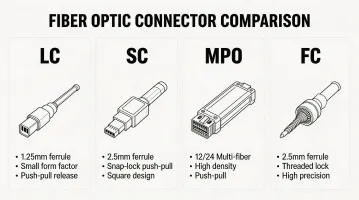
Fiber Connector Guide
Guide

Fiber Optic Connector Selection Guide

Compare LC, SC, MPO, FC, and ST connectors by insertion loss, density, ease of termination, and cost per port. Includes a decision flowchart for common applications.

Download PDF →
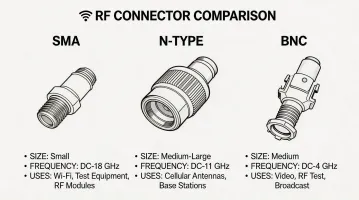
RF Connector Guide
Guide

RF Connector Selection Guide

SMA, N-Type, BNC, TNC, and 7/16 DIN compared by frequency range, power handling, impedance, and environmental rating. Includes application mapping for each interface.

Download PDF →
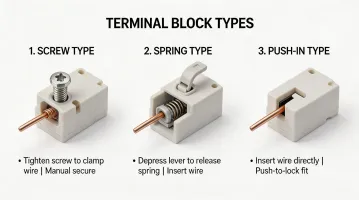
Terminal Block Guide
Guide

Terminal Block Selection Guide

Screw-clamp, spring-cage, and push-in designs compared by wire range, current rating, vibration resistance, and installation speed. Mounting options covered.

Download PDF →

Technical Comparisons

Head-to-head connector comparisons to help you evaluate alternatives quickly.

Comparison

SMA vs N-Type Connectors

Frequency range, power capacity, size, and typical applications compared. SMA excels below 18 GHz in compact designs, while N-Type handles higher power and outdoor environments up to 11 GHz.

Read Full Comparison →
Comparison

MPO vs MTP Connectors

Both are multi-fiber push-on designs, but MTP (by US Conec) adds features like removable housing and spring-loaded ferrule. Learn when each option delivers better value for data center deployments.

Read Full Comparison →
Comparison

LC vs SC Fiber Connectors

LC connectors offer 50% higher port density with small form factor, while SC remains popular in older installations and PON terminals. Performance metrics, cost, and migration considerations covered.

Read Full Comparison →
Comparison

UPC vs APC Fiber Polish

Ultra Physical Contact (UPC) offers ≥50 dB return loss, while Angled Physical Contact (APC) exceeds 60 dB. APC is essential for analog CATV and long-haul DWDM systems where back-reflection matters.

Read Full Comparison →

Installation & Maintenance Tutorials

Step-by-step guidance from our engineering team.

Fiber Connector Cleaning Best Practices

Contaminated end-faces are the number one cause of fiber network issues. Learn the correct wet-dry cleaning method and inspection standards (IEC 61300-3-35) to maintain insertion loss below spec.

View Tutorial →

RF Connector Torque Specifications

Over-tightening damages threads and increases PIM. Under-tightening causes intermittent connections. Reference our torque chart for SMA (5 in-lbs), N-Type (12-15 in-lbs), and 7/16 DIN (20-25 in-lbs).

View Tutorial →

Terminal Block Wiring Guide

Proper strip lengths, wire gauge compatibility, and torque settings for screw-clamp and spring-cage terminal blocks. Includes common wiring mistakes and how to avoid them.

View Tutorial →

Selection Considerations & Industry Trade-offs

Connector selection often depends on broader infrastructure decisions. Understanding these trade-offs helps you specify the right interface from the start.

Fiber Optic vs. Copper for Last-Mile Connectivity

Telecom operators deploying last-mile access face a persistent infrastructure question: should they invest in full fiber-to-the-premises (FTTP) or extend the life of existing copper plant using technologies like G.fast and VDSL2 vectoring?

Case for fiber: FTTP delivers future-proof bandwidth (symmetrical 1 Gbps and beyond), lower long-term maintenance costs (no powered field electronics), and superior latency for real-time applications like video conferencing and cloud computing. Fiber connectors (SC/APC, LC) at each termination point add minimal insertion loss (≤0.3 dB) and remain stable over decades.

Case for enhanced copper: G.fast vectoring delivers up to 1 Gbps over short copper loops (<250 m) with zero new outside plant construction. For operators with dense existing copper infrastructure, the upfront deployment cost is 40-60% lower than greenfield fiber. This approach buys time while fiber buildout continues in phases.

Implication for connector selection: Fiber deployments require high-quality SC/APC or LC connectors rated for outdoor splice closures and distribution terminals. Copper-extended networks still need fiber connectors at the DSLAM/DPU cabinet level but fewer per subscriber.

Active Optical Networks (AON) vs. Passive Optical Networks (PON)

When deploying fiber access networks, the choice between AON and PON architectures affects connector density, splice points, and maintenance requirements throughout the network.

Case for AON: Active Ethernet provides dedicated bandwidth per subscriber with point-to-point fiber runs. Each subscriber gets a dedicated fiber and connector pair, simplifying troubleshooting. AON reaches up to 80 km without repeaters and is preferred by enterprise customers who need guaranteed bandwidth SLAs.

Case for PON: GPON and XGS-PON use unpowered optical splitters (1:32 or 1:64 ratios) to share a single feeder fiber among multiple subscribers. This reduces the total fiber count and connector count in the outside plant by 60-80%, lowering material and installation costs. PON is the dominant architecture for residential FTTH deployments worldwide.

Implication for connector selection: AON networks require more individual SC/LC connectors at distribution frames but fewer splitter-grade components. PON networks need high-precision splitter pigtails with tight insertion loss tolerances (≤0.15 dB) to preserve the shared optical budget across split ratios.

Connector FAQ

Insertion loss measures how much optical power is lost when light passes through a connector. Lower is better. For single-mode fiber connectors, typical insertion loss is 0.1-0.3 dB per mating pair. In DWDM systems and long-haul links, every 0.1 dB matters because it directly affects your link budget and maximum transmission distance.

For protected outdoor environments (cabinets, sheltered poles), IP65 is usually sufficient. For direct exposure to rain, dust, and temperature extremes, IP67 is recommended. IP68 rated connectors are available for submersible or underground applications. Always verify that the IP rating covers the mated pair, not just the connector body.

VSWR (Voltage Standing Wave Ratio) is measured using a vector network analyzer (VNA) or a directional coupler with a power meter. A VSWR of 1.0:1 is perfect matching; most quality RF connectors achieve 1.15:1 to 1.5:1 depending on frequency. For base station applications, VSWR should be below 1.3:1 across the operating band.

Need Help Choosing?

Our engineers are available to walk you through the selection process. No commitment required.

Ask an Engineer